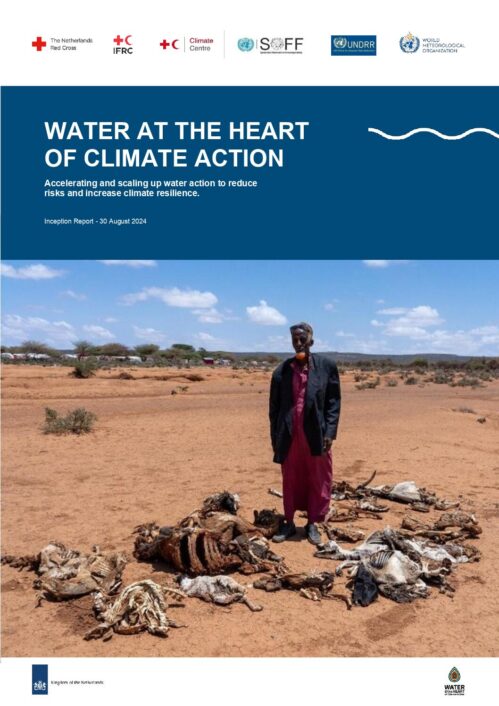
Water at the Heart of Climate Action – Accelerating and scaling up water action to reduce risks and increase climate resilience.
Inception Report – 30 August 2024
A unique collaboration of the International Federation of Red Cross and Red Crescent Societies (IFRC), the
Netherlands Red Cross (NLRC), the Red Cross Climate Centre (“the Climate Centre”), the Systematic
Observations Financing Facility (SOFF), the UN Office for Disaster Risk Reduction (UNDRR) and the World
Meteorological Organization (WMO) is well positioned to integrate their ways of working and collaborate with
governments and communities to reduce climate vulnerability in Ethiopia, Rwanda, South Sudan, Sudan
and Uganda for end-to-end community-centered Early Warning Systems (EWS). This inception report builds
on the Water at the Heart of Climate Action (WHCA) proposal which was approved by the Netherlands
Ministry of Foreign Affairs (MoFA) on 21 July 2023 and provides information on how the consortium aims to
achieve the objective of accelerating and scaling up water actions to reduce impacts and increase resilience
of vulnerable communities in the five selected countries through an integrated, systemic, silo-breaking
approach.
Five technical focus areas are central to the consortium-level theory of change outcomes:
• Outcome 1: Water-related risk knowledge and governance – Weather- and water-related
disaster risk information system(s), established through participatory and inclusive processes, and
effectively applying local, national and global level data, inform(s) decision-making to support
affected communities with community-centered solutions for risk management.
• Outcome 2: Observations, monitoring and forecasting of weather- and water-related hazards
– Improved production of and access to climate, weather and water observation, monitoring and
impact-based forecasting/prediction products in order to deliver flood and drought warning services
to various stakeholders for decision-making.
• Outcome 3: Water-specific early warning systems dissemination and communication – Most
at-risk communities access relevant, timely, understandable, and actionable water-related alert/early
warning messages that could enable them to take actions to protect lives, livelihoods and critical
infrastructure.
• Outcome 4: Anticipatory action and locally led adaptation – Strengthened preparedness to take
anticipatory action in response to warnings and enhanced locally led water-related climate
adaptation capacities that could contribute to the reduction of water-related risks.
• Outcome 5: Cross-cutting – Cross-cutting enabling activities are implemented to ensure effective
community and stakeholder engagement, response to protection-gender-inclusion needs, strong
inter-TFA linkages, a cross-fertilization of learning, efficient knowledge management and high-quality
actions.

 English